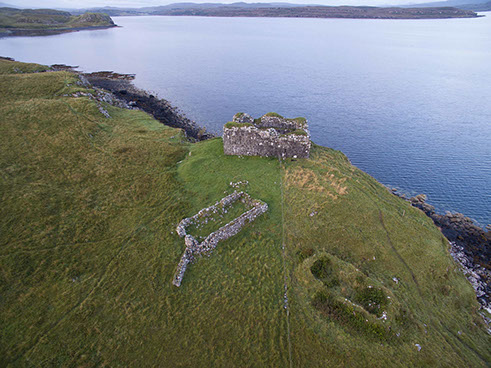
Caisteal Uisdean, or Hugh’s Castle, sits upon the easterly cliffs of Skye’s Trotternish peninsula, about three miles south of Uig. The simple stone structure was once home to a very complex character, Hugh MacDonald, who met with a particularly dark demise in the dungeons of Duntulm Castle after conspiring against the Chief of the Clan MacDonalds of Sleat. I have often seen Hugh discussed concerning both Caisteal Uisdean and Duntulm Castle, however, many of these authors have assumed Hugh’s identity and relation to the Clan Chief which he conspired against, wrongly assuming him to be the uncle or nephew. Therefore, this post discovered Hugh Macdonald’s true identity as well as providing the correct relationship between Hugh and the MacDonald chief.
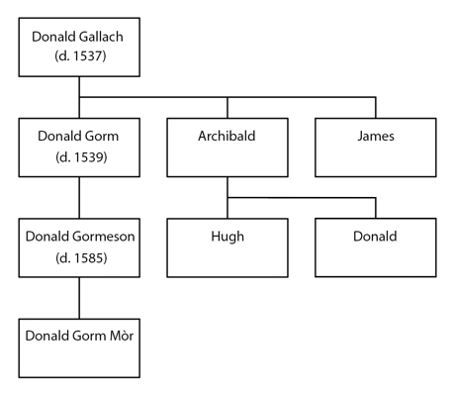
Hugh was the son of Archibald the Cleric (Gillesbaig Clèireach), who was the younger son of Donald Gallach MacDonald, the 4th chief of Sleat. Archibald, therefore, was not heir to the chieftaincy, Donald Gorm, his older brother was. However, following the untimely deaths of his father and brother, in 1539 the chieftaincy passed to Archibald since his nephew, Donald Gormeson, was too young to take over. He sent his nephew to England, presumably for his safety, but at some point between 1539 and 1554 (probably closer to 1554), Archibald died and Donald Gormeson returned to Skye to take his place as Chief of the MacDonalds until he died in 1585 and was succeeded by his son, Donald Gorm Mòr.
Donald was still young at the time and was entrusted to his surviving granduncle (Archibald and Donald Gorm’s brother), Seamus, who resided at Caisteal Camus, also known as Knock Castle, in the south of Skye. However, whilst sailing south their ship was attacked by their rivals, the Clan MacLean, who massacred all aboard except the young chieftain, sparking a conflict that would last four years from 1585 to 1589.
It is during this conflict that we see Hugh rise to prominence. He and his loyal followers carried out piratical, almost Viking-like raids (Viking of course literally meaning pirate or raider). They stole cattle, attacked settlements, and anything that could cause damage to their rivals, allowing Hugh to assume a large sum of money and grow his ever-loyal crew of clansmen, many of whom were likely left over from his father’s brief stint as Clan Chief.
For his service, Donald Gorm Mòr, Hugh’s first cousin once removed, gave him stewardship of the Trotternish Peninsula, where with his small fortune, he constructed his castle – Caisteal Uisdean (Although it’s not known for certain whether he had already started construction of his castle by this point or whether he had constructed it before the feud). But things were about to go wrong.
Hugh seemingly held resentment for his cousin, possibly suspecting that his father had been killed by the chieftain’s father, meaning that Hugh probably felt that the chieftaincy was rightfully his. So, he set about a way to put this right, by inviting his cousin to his castle and having him assassinated so that he could take his rightful seat as chief. However, Hugh made a fatal mistake. He wrote two letters, one to a would-be assassin, and the other inviting the Chief to his castle, but they were mixed up, and Donald received the letter meant for the assassin alerting him to the conspiracy and causing Hugh to go on the run.
He escaped to the Outer Hebrides for a while, taking refuge at Dun an Sticr on North Uist, something which is believed to have been the namesake for Dun an Sticr, since it is sometimes translated to mean ‘The Fort of the Skulker’. However, during his hiding, he was betrayed by a local woman who brought him food, and in 1602, he was captured and transported back to Duntulm to face his punishment.
Hugh was thrown into the lower dungeons of Duntulm castle, where he was denied water and fed only salted fish and salted beef. The eruption of the waves below him and the salt on the air will have made his thirst unbearable and was said to have driven him to insanity, his desperate screams echoing throughout the castle as the salt sucked his life out of him until eventually, he passed away in undeniable agony. If you visit Duntulm today and listen to the wind between the crashing of waves on the rocks, then it’s said that you can still hear his cries of agony and desperation, so make sure to listen carefully and also stay away from the edge and respect the fences that are in place since the cliff is eroding and not stable!
So here we have it, a story of Steel and Salt, a Hebridean pirate who met a gruesome and salty demise. But we also have discovered the truth of his relation to the MacDonald chief. Donald Gorm Mòr was not the uncle, or nephew of Hugh MacDonald as previously thought, instead, he was the first cousin once removed (his cousin’s son to put it simply). Skye has many a gruesome tale hidden beneath the beautiful scenery, but only if you know how to look for them.
Check out my Blog page for more entries on Skye or Scottish History.
Sources:
https://canmore.org.uk/site/10294/north-uist-dun-an-sticer
https://canmore.org.uk/site/11121/skye-caisteal-uisdein
Macdonald, Angus; Macdonald, Archibald (1900). The Clan Donald. Vol. 3. Inverness: The Northern Counties Publishing Company, Ltd.
M. Coventry (2006), The Castles of Scotland, Fourth Edition, Birlinn Limited.
O. Swire (1999), Skye. The island and its legends. Third Edition Maclean Press.

One response to “Salt and Steel: Hugh MacDonald, the Hebridean Pirate of Caisteal Uisdean”
-
phenomenal! 33 2025 The Minotaur’s Labyrinth: Could the Papoura Hill Circular structure be the lair of the Mythical Beast? pretty
LikeLike


Leave a Reply