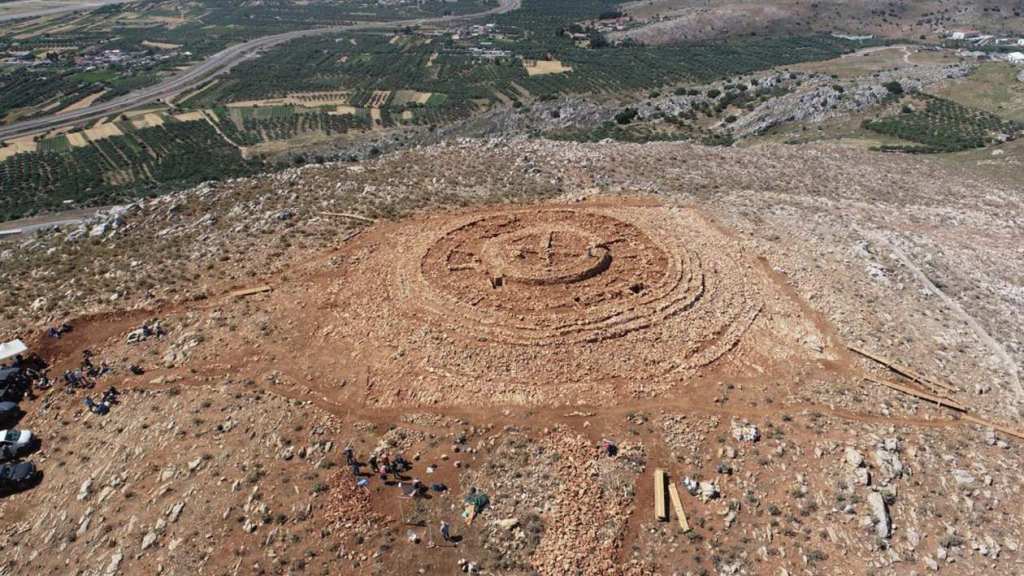
The Half-Man Half-Bull creature has captured the imagination of so many throughout the centuries. The Myth of the Minotaur and the Legendary figure of King Minos find themselves as the namesake for an entire civilisation – The Minoans – whose roots proceed the Mycenaeans as one of the oldest civilisations in Europe. Some have even suggested that it was the advancing and expanding might of the Mycenaeans who brought the fiery downfall of the Minoan civilisation that has been observed in the archaeological ruins of the palace of Knossos.
I find myself rather intrigued by this discovery. I confess that I found it on Facebook of all places, a fairly shabbily written article that was by no means written by a scholar, classicist, or even an archaeologist. An author who seemed certain and confident that the remains of the circular structure on Papoura Hill was the location of the Minotaur’s Labyrinth.
Looking back to one of my first lectures on Classical Greek History, we were asked a question – “Which of these figures/things from ancient were definitely real? Homer, King Agamemnon, Troy, or the Minotaur?”
The question is indeed a difficult one to think about. They all are known through Mythology. Perhaps Homer is the odd one out? A writer of the Mythology of Troy, the Trojan War and King Agamemnon. However, as any keen Classicist should know, the author “Homer” is just as mythological as the works of the Iliad and Odyssey.
The correct answer to this question is the city of Troy, we have archaeological evidence of the city in modern-day Türkyie, but of course, this does not immediately disprove the existence of Agamemnon or even Homer and the stories that he told. Returning to the issue of the Minotaur’s existence. It is highly (and I mean, very highly) unlikely that Queen Pasiphae gave birth to a half-man half-bull creature. And even discovering a giant mysterious maze that could be perceived as the Labyrinth, doesn’t allude to the existence of such a creature, just as the discovery of the city of Troy doesn’t immediately confirm the authenticity of the Trojan War and the figures mentioned in Homer’s epic poems. (Sorry to any diehard mythology fans!)
However, despite this, we can find ourselves faced with a more realistic probability. King Minos. He has often been recorded and mentioned throughout History in line with the myth of the Minotaur, and just like the mythological king Agamemnon, he may well have existed. Perhaps it makes sense for him to have existed since there are sources that mention him. But we must put aside the assumption and connection to him as the sort of stepfather to the Minotaur, and instead, due to the ‘Mino’ aspect of their names, explore them as the same person.
Myths often come from a twinkle of truth in unrecorded history. Stories passed down from generation to generation, becoming clouded over like a shard of frosted glass. An element of truth must be in there somewhere, either in a figure, a place, a time, or an event. Therefore, we can never chalk myths off entirely.
It is rather easy to see how certain misconceptions/interpretations can dissolve into myths. Imagine finding a Dinosaur skull and not knowing what it was, add a little exaggeration and you can see how the myth of the Dragon was born. The same goes for the Cyclops, the single-eyed giants that roamed the ancient Mediterranean (supposedly). Well, upon finding the skulls of an extinct breed of elephant, known as the Pygmy Elephant, in caves around southern Italy, experts have deduced that it may have been these that inspired the myth of the Cyclops.

With so many myths based on an interpretation or reimagining/exaggeration of a true story, we can begin to unravel these myths and try to work out the most likely scenario that triggered their creation. Therefore, moving back to the myth of the Minotaur, we must start to combine the two legends, the Man and the Myth.
One of the most common ideas amongst scholars is that King Minos and the Minotaur were one and the same. The Minotaur possibly being a title bestowed to King Minos, or perhaps how he was known amongst his enemies. The material evidence at the Palace of Knossos tells us that the Minoans were crazy about Bulls. They worshipped them. There are many examples of Bulls in art found on pottery as well as statues that depict men and women leaping over rampaging Bulls, in a very similar style to Spanish bullfighting.
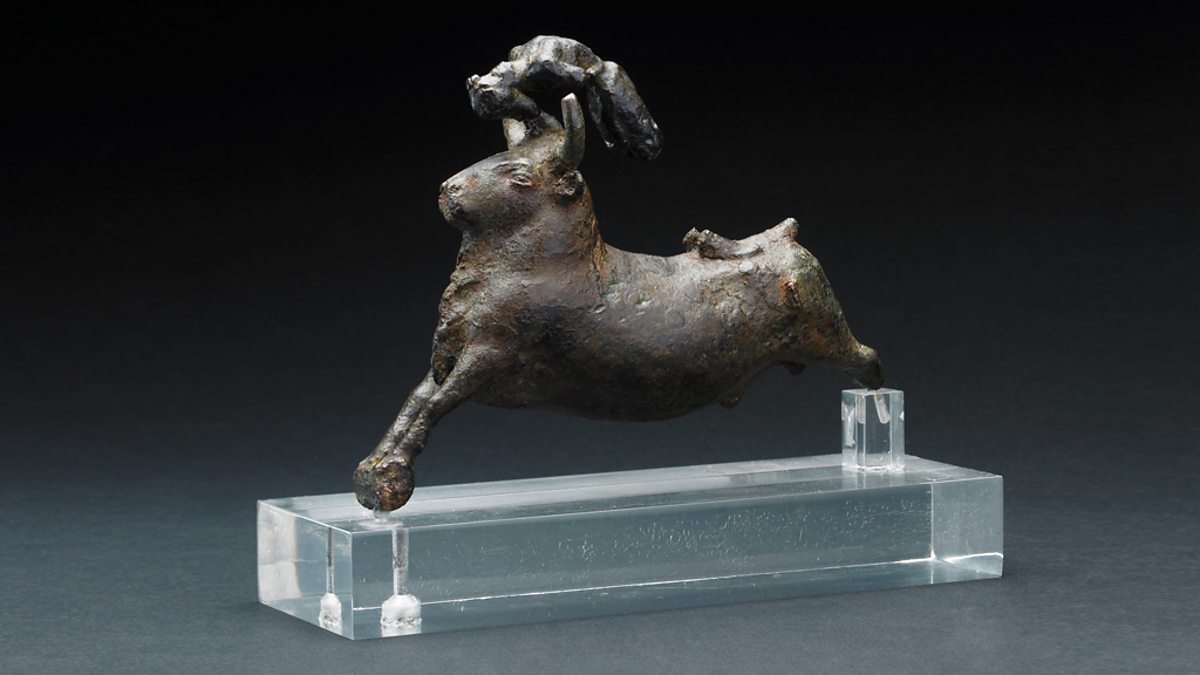
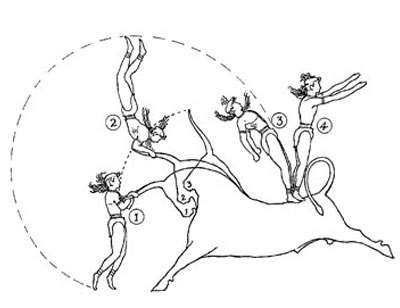
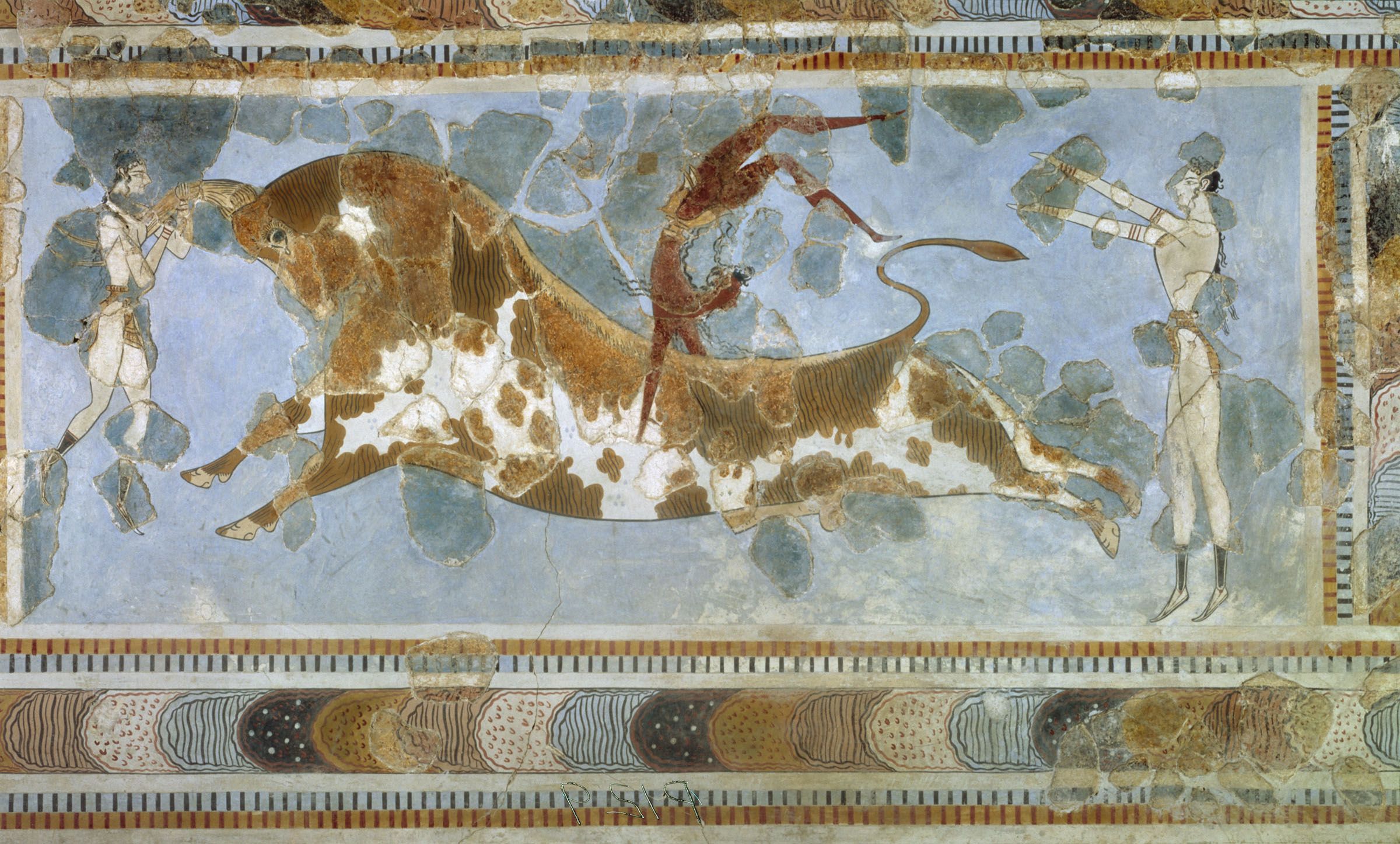
Bulls were important in Knossos, and it is most likely this connection between the legendary King Minos (Existent or not) and the Bulls worshipped and leapt at Knossos, that led to the myth of the Minotaur. Other ideas remain conjecture, perhaps Minos wore a Bull’s mask in battle and that’s how he earned his name, perhaps he was a prophet character who introduced a bull deity to the people of Crete? There are many possibilities as to who King Minos was that will remain ideas until they can either be proven, or disproven.
As for the question regarding the location of the Minotaur’s Labyrinth, if we analyse the myth in light of what has previously been discussed vis a vis Minos’ role as the Minotaur, as well as hours of scouring the floor plans of the Palace of Knossos, the only place that the Labyrinth could have been, was the Palace of Knossos itself. If we use the information we have been given via the myth of Theseus and the Minotaur and use the material evidence from the Palace of Knossos, we will be able to see parallels to identify if Knossos is indeed the Labyrinth referred to in the myth.
Firstly, the Myths states that the labyrinth is where the Minotaur dwells… Check! Knossos is supposedly where King Minos dwelt.
Secondly, the labyrinth descended deep underground… Check! Knossos has many levels, including a few that go underground.
And finally, the Labyrinth was a twisting maze… Check! You only have to look at the floor plans of Knossos to see that it is a highly complex and (Excuse the pun) an a-maze-ing structure.
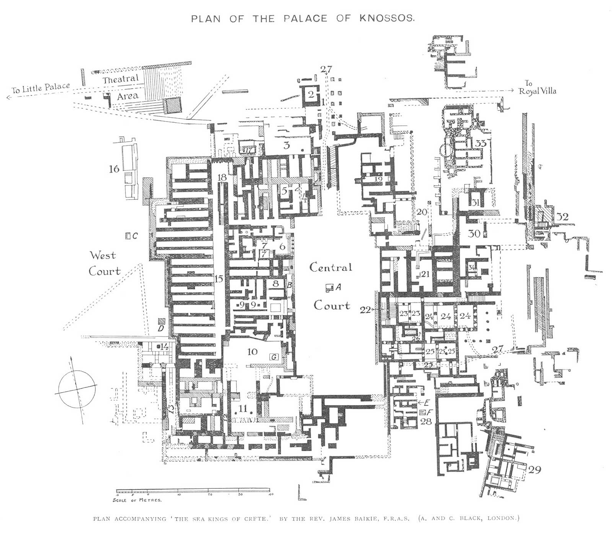
From these things, it would be safe to say, that the Labyrinth described in the myth of the Minotaur was actually an exaggeration of Knossos. Therefore, being the point of this article, the circular hill structure on Papoura Hill is likely not the Minotaur’s Labyrinth.
In that case… what was it?
Since it is only a very recent discovery, it is still undergoing excavation and examination to determine the use of the structure that has been found. Though from some of the artefacts that have been uncovered, some assumptions have been made and suggested as to the building’s use.
The building dates to the middle Minoan period and was used mostly between 2000 and 1700 BCE. Pottery found during the dubbed “Destruction Layer” was early neopalatial (Late Minoan), which is what allows us to pinpoint the duration and last period of habitation or use. As for the use of the structure, large quantities of animal bones have been found, which suggests either sacrifice or consumption took place within or around the structure. Therefore, this could mean that it was either a ceremonial or religious place or a community hall for people to gather and consume food (Animal meat) and wine.
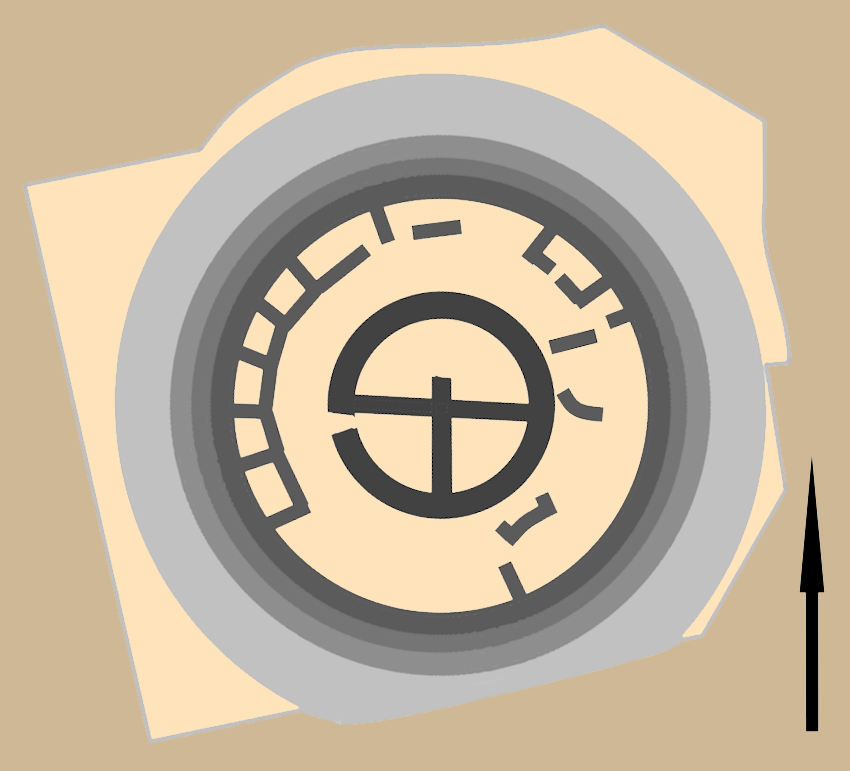
However, this is not the only suggestion that has been put forward. Experts have also pointed out that there are structural similarities to vaulted tombs in southern Crete and mainland Greece, but with no other similar discoveries, what it was used for will remain up for debate.
Perhaps it was a burial site for the bulls worshipped at Knossos like the Serapeum of Saqqara in Egypt? Or maybe a hilltop refuge for farmers in the surrounding area? It could have been a burial place for a wealthy landowner or King. Or even a gathering place for religious festivities. Whatever it was, we have now found it, and our knowledge of the past can only grow as it is studied in more depth and more discoveries come to light. Although, something that I am sure of, is that it was most certainly not the Minotaur’s Labyrinth.

 Alasdair MacIlleathain
Leave a comment